Free BMI Calculator & Vital Report: Check Your Health Online in Seconds
Free BMI Calculator & Vital Report: Check Your Health Online in Seconds
MaruCare's free vital report tool calculates your BMI and ideal body weight and marks your blood pressure, pulse, oxygen level (SpO2) and body temperature as Normal, High or Low. It takes a few seconds, is free, and gives you a report you can print, save as a PDF or share on WhatsApp. Your details are worked out on your own phone and are not sent to or stored by us.
Get your free vital report here
Most of us only check our health numbers when something feels wrong. But knowing your BMI, blood pressure, pulse and oxygen level when you feel fine gives you a baseline, and a way to spot changes early. That is why we built a simple, free tool: enter a few readings and get a clear health snapshot in seconds.
What is the free vital report?
The vital report is an online health snapshot made from readings you type in. You enter:
- Your name and year of birth
- Blood pressure (upper and lower numbers)
- Pulse (beats per minute)
- Oxygen level, SpO2 (%)
- Body temperature (in °F or °C)
- Height (in centimetres, or feet and inches) and weight (in kg)
In return you get:
- Blood pressure, pulse, oxygen and temperature, each marked Normal, High or Low
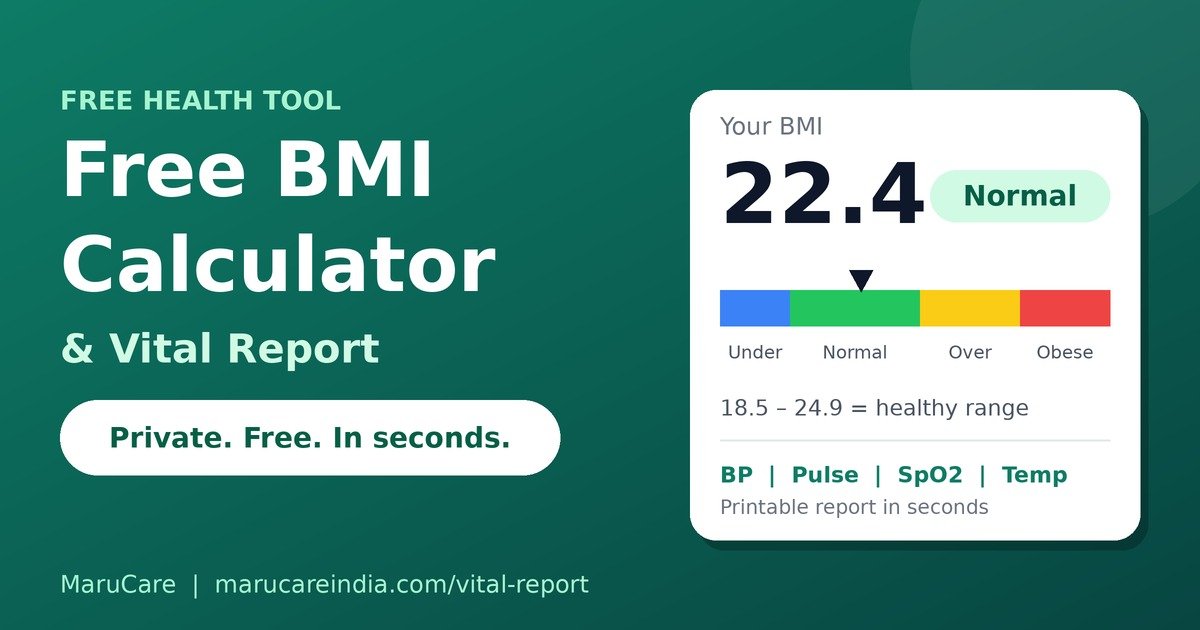
- BMI with a colour scale, so you can see where you stand
- Your ideal body weight
- Simple tips on diet, exercise, sleep and stress
- A report to print, save as a PDF or share on WhatsApp
It is meant for adults aged 18 and above, because normal ranges for children and teenagers are different.
What is BMI?
BMI stands for Body Mass Index. It is a quick way to see whether your weight is healthy for your height. The formula is:
BMI = weight in kilograms ÷ (height in metres × height in metres)
For example, a person who weighs 70 kg and is 1.70 m tall has a BMI of 70 ÷ (1.70 × 1.70) = about 24.2.
BMI categories used in our report
- Underweight: below 18.5
- Normal: 18.5 to 24.9
- Overweight: 25 to 29.9
- Obese: 30 and above
A note for Indians: Several Indian and Asian guidelines suggest lower cut-offs, because South Asians tend to carry more body fat and face higher risk of diabetes and heart disease at a lower BMI. Many guidelines treat a BMI of 23 and above as overweight and 25 and above as obese for Asian adults. So if your BMI is in the upper part of the normal range, it is worth checking your waist size and talking to your doctor, especially if diabetes or heart disease runs in your family.
Limits of BMI
BMI is a screening tool, not a diagnosis. It does not tell the difference between muscle and fat, so it can read high for athletes and people with a lot of muscle. It also does not show where fat is stored. Belly fat is more risky than fat on the hips and thighs. Use BMI together with waist circumference, blood tests and your doctor's advice.
What is your ideal body weight?
Your report also shows an ideal body weight for your height. Think of it as a healthy target range rather than an exact number. Your frame, age, muscle mass and health conditions all affect what is right for you. If you are far from your ideal weight, aim for slow, steady change, such as losing around 0.5 to 1 kg a week, instead of crash diets.
Normal ranges used in the report
- Blood pressure: upper (systolic) 90 to 129 mmHg and lower (diastolic) 60 to 89 mmHg
- Resting pulse: 60 to 100 beats per minute
- Oxygen level (SpO2): 95 to 100 percent
- Body temperature: 95 to 99 °F (35 to 37.2 °C)
- BMI: 18.5 to 24.9
Your doctor may set different targets for you, especially if you have a long-term condition such as hypertension, diabetes, heart or lung disease.
Why these vital signs matter
Blood pressure: High blood pressure often has no symptoms but quietly strains the heart, brain, kidneys and eyes. Low blood pressure can cause dizziness and fainting.
Pulse: A resting pulse that is consistently very fast or very slow, or irregular, deserves a medical check. Fitness, stress, caffeine, fever and some medicines can change your pulse.
Oxygen level (SpO2): This shows how well oxygen is reaching your blood. A reading below 95 percent, or a drop from your usual level, needs attention. Seek medical help urgently if it is low and you have trouble breathing.
Temperature: A temperature above the normal range suggests fever, which often points to an infection. A low reading can happen in cold surroundings or in some illnesses.
BMI and weight: Excess weight is linked with diabetes, high blood pressure, high cholesterol, fatty liver and joint problems. Being underweight can point to poor nutrition, low iron or vitamin levels, or other conditions.
How to measure your readings correctly
Wrong readings give a wrong report, so take a few minutes to measure properly:
Blood pressure: sit and rest for 5 minutes, keep your arm at heart level, feet flat, back supported, and do not talk during the reading. Avoid coffee, smoking and exercise for 30 minutes before.
Pulse: count for a full minute while resting, or use a reliable device.
Oxygen (SpO2): use a clean, warm finger without nail polish and keep your hand still. Cold hands can give false low readings.
Temperature: use the same thermometer each time and follow its instructions.
Height and weight: measure height without shoes, and weigh yourself in the morning in light clothes. Use the same scale each time.
Use the same device each time so that you can compare your results properly.
How to use the free vital report: step by step
Open the free vital report page on your phone or computer.
Enter your name and year of birth.
Type in your blood pressure, pulse, oxygen level, temperature, height and weight.
Tap "Create my report".
Read your results, then print the report, save it as a PDF or share it on WhatsApp.
Repeat it every month or two to track your progress.
Is my data safe?
Yes. The report is created inside your own phone or computer. Your name and readings are not sent to MaruCare and are not stored.
Who should use it?
Adults who want a quick health snapshot at home
Anyone starting a weight loss, fitness or diet plan who wants a starting point
People with high blood pressure, diabetes or heart conditions who track their readings regularly
Families who want to help elderly parents keep a simple record of their vitals
Anyone who wants a printed summary to show their doctor
What this report cannot do
The vital report is a quick snapshot, not a medical diagnosis, and it is not a lab test. It cannot tell you your blood sugar, cholesterol, thyroid, vitamin levels, kidney or liver function, or find the cause of any problem. If a reading is outside the normal range, if you feel unwell, or if you have chest pain, severe breathlessness or fainting, speak to a doctor or seek emergency care right away.
Next step: tests that go beyond the numbers
Your vital report tells you how your body is doing today. Blood tests tell you what is happening inside. Depending on your report and your doctor's advice, useful tests include:
HbA1c and fasting blood sugar, for diabetes risk
Lipid profile, for cholesterol and heart health
Thyroid profile, if weight or energy levels are changing
Vitamin D and vitamin B12, for tiredness and weakness
Complete blood count (CBC), for anaemia and infection
Liver and kidney function tests, for overall organ health
A full body checkup, to cover many of these in one visit
MaruCare offers home sample collection in Mumbai, Navi Mumbai and Pune, with reports from NABL, ICMR and ISO certified lab partners. See our health checkup packages or book a test. You can also upload your doctor's prescription and our team will call you to book your tests. Call or WhatsApp us on +91 86527 57415.
Frequently asked questions
Q: Is the MaruCare vital report free?
A: Yes. It is completely free to use, and you do not need to register.
Q: Is the vital report a medical diagnosis?
A: No. It is a quick snapshot based on the readings you enter. If any reading worries you, or you feel unwell, talk to a doctor.
Q: Are my details saved or shared?
A: No. The report is made on your own phone or computer. Your name and readings are not sent to MaruCare or stored.
Q: Who can use the BMI calculator and vital report?
A: Adults aged 18 and above. Normal ranges for blood pressure, pulse and BMI are different for children and teenagers.
Q: What is a healthy BMI?
A: A BMI of 18.5 to 24.9 is considered normal. Many Asian guidelines treat 23 and above as overweight, so talk to your doctor about what is right for you.
Q: What is a normal blood pressure reading?
A: For adults, the report treats an upper number of 90 to 129 mmHg and a lower number of 60 to 89 mmHg as normal.
Q: What is a normal oxygen level?
A: An SpO2 of 95 to 100 percent is considered normal. A reading below 95 percent should be checked by a doctor, and urgently if you feel breathless.
Q: How often should I check my vitals?
A: If you are healthy, once a month or every few months is fine. If you have a condition such as hypertension or diabetes, follow your doctor's advice on how often to check.
Q: Can I share the report with my doctor?
A: Yes. You can print it, save it as a PDF or share it on WhatsApp.
Create your free vital report now: marucareindia.com/vital-report
Disclaimer: This article and the vital report tool are for general information only and are not medical advice or a diagnosis. Normal ranges can differ for individuals. Please consult a qualified doctor about your results and before making major changes to your diet, exercise or medicines.
This article is for general information and is not a substitute for medical advice. Please talk to your doctor about your own health.