Red Blood Cells: Functions, Normal Count & Health Importance
Red Blood Cells (RBC): Functions, Normal Count & Health Importance
Red blood cells (RBCs) carry oxygen from your lungs to every part of your body and bring carbon dioxide back to be breathed out. A normal RBC count is roughly 4.5 to 5.9 million cells per microlitre of blood in adult men and 4.1 to 5.1 million in adult women. Exact ranges vary slightly between laboratories, so always compare your result with the range printed on your report.
Every minute of every day, billions of red blood cells are delivering oxygen to your brain, heart, muscles and organs. When their number or quality drops, you feel tired, weak and breathless. When it rises too high, your blood can thicken and strain your heart. That is why the RBC count is one of the most important numbers on a routine blood report. This guide explains what red blood cells are, what they do, what a normal count looks like, and what abnormal results can mean.
**What are red blood cells?**
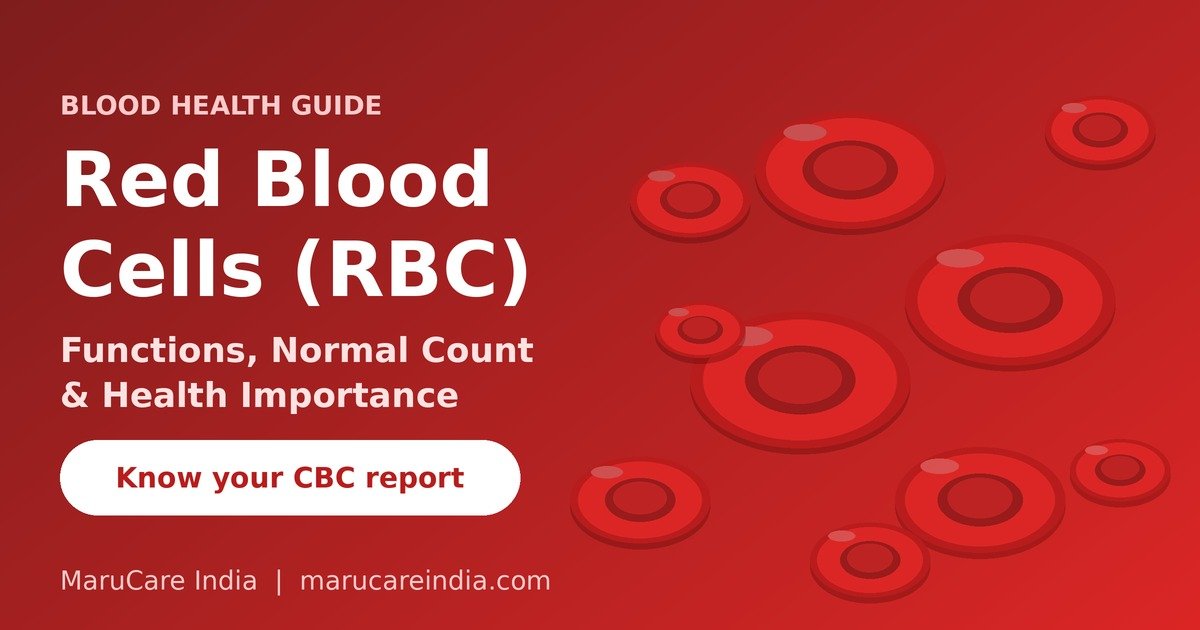
Red blood cells, also called erythrocytes, are the most common cells in your blood. They are small, round, disc-shaped cells that are thinner in the middle, like a doughnut without a hole. This shape gives them a large surface area to pick up oxygen and lets them squeeze through the tiniest blood vessels.
Their red colour comes from haemoglobin, an iron-rich protein that binds to oxygen. Mature red blood cells do not have a nucleus, which leaves more room inside the cell for haemoglobin.
**Where are red blood cells made?**
Red blood cells are made in the bone marrow, the soft tissue inside your bones. The kidneys help control this process by releasing a hormone called erythropoietin (EPO) whenever the body senses low oxygen levels. To build healthy red cells, your body needs enough iron, vitamin B12 and folate (vitamin B9).
A red blood cell lives for about 120 days. After that, the spleen and liver remove old cells, and the body recycles their iron to make new ones.
**Functions of red blood cells**
- 1. **Carry oxygen:** Haemoglobin picks up oxygen in the lungs and releases it to tissues throughout the body.
- 2. **Remove carbon dioxide:** RBCs carry some of the carbon dioxide produced by cells back to the lungs, where you breathe it out.
- 3. **Maintain blood pH:** Haemoglobin helps buffer the blood and keep its acid-base balance steady.
- 4. **Support blood flow:** Healthy, flexible RBCs move smoothly through narrow capillaries, helping oxygen reach every organ.
- 5. **Give blood its colour and thickness:** RBCs make up nearly half of your blood volume.
**Normal RBC count**
The RBC count measures the number of red blood cells in a small amount of blood. It is reported in million cells per microlitre (million/µL, also written million/cumm).
Typical adult ranges are:
- - Adult men: about 4.5 to 5.9 million/µL
- - Adult women: about 4.1 to 5.1 million/µL
- - Children: about 4.0 to 5.5 million/µL, varying with age
- - Newborns: higher, often about 4.8 to 7.0 million/µL in the first days of life
Reference ranges differ between labs, between machines and between regions, and some Indian labs print slightly lower ranges. Pregnancy, altitude and age also affect results. Always use the range shown on your own report.
**RBC count is part of the CBC test**
The RBC count is reported as part of a Complete Blood Count (CBC), along with other values that explain the size and quality of your red cells:
- - **Haemoglobin (Hb):** the oxygen-carrying protein in RBCs
- - **Hematocrit (HCT/PCV):** the percentage of your blood made up of red cells
- - **MCV:** the average size of red cells (small, normal or large)
- - **MCH and MCHC:** how much haemoglobin each cell carries
- - **RDW:** how much red cells vary in size
Doctors look at these values together, because the RBC count alone does not give the full picture.
**Low RBC count: causes and symptoms**
A low RBC count usually points to anaemia, which means the blood cannot carry enough oxygen.
*Common causes:*
- - Iron deficiency, the most common cause in India
- - Vitamin B12 or folate deficiency
- - Blood loss from heavy periods, ulcers, piles or injury
- - Chronic kidney disease, which reduces EPO production
- - Chronic infections or inflammatory diseases
- - Bone marrow problems and some cancers or cancer treatments
- - Inherited conditions such as thalassaemia and sickle cell disease
- - Pregnancy, when blood volume increases and needs more iron
*Symptoms:*
- - Constant tiredness and weakness
- - Pale or yellowish skin
- - Shortness of breath or fast heartbeat
- - Dizziness, headaches or cold hands and feet
- - Brittle nails, hair fall, difficulty concentrating
High RBC count: causes and symptoms**
A high RBC count is called erythrocytosis (or polycythaemia). It makes blood thicker and can raise the risk of clots.
*Common causes:*
- - Dehydration, which makes the count look high
- - Smoking
- - Living at high altitude
- - Chronic lung diseases such as COPD, or sleep apnoea
- - Heart disease
- - Excess EPO or testosterone use, including some supplements and performance drugs
- - Polycythaemia vera, a rare bone marrow disorder
*Symptoms:*
- - Headache, dizziness or blurred vision
- - Redness of the face
- - Itching, especially after a warm bath
- - Fatigue, and sometimes high blood pressure
**How to keep your red blood cells healthy**
- - **Eat iron-rich foods:** leafy greens, beetroot, dates, jaggery, chana, rajma, lentils, pumpkin seeds, eggs, meat and fish.
- - **Pair iron with vitamin C:** lemon, amla, oranges and guava help your body absorb iron from plant foods.
- - **Get enough B12 and folate:** milk, curd, eggs, fish, fortified foods, and green vegetables and pulses. Vegetarians and vegans often need B12 checks or supplements.
- - **Limit tea and coffee around meals:** they can reduce iron absorption.
Stay hydrated.
Do not smoke.
- it supports healthy circulation.
- When should you get an RBC count or CBC test?**
Consider a CBC if you have:
- - Ongoing fatigue, weakness or breathlessness
- - Pale skin, dizziness or frequent headaches
- - Heavy periods, bleeding or black stools
- - A family history of anaemia or blood disorders
- - A planned surgery, pregnancy or yearly health checkup
A CBC is a simple blood test, and results are usually ready the same day. If your RBC count is abnormal, your doctor may suggest follow-up tests such as ferritin and iron studies, vitamin B12, folate, a peripheral smear, kidney function or thyroid tests.
**Know your blood health with MaruCare India.** Book a CBC test or a full body checkup from the comfort of home and get clear, accurate reports.
**Frequently asked questions**
Q: What is the normal RBC count? ||
A: For adults, it is roughly 4.5 to 5.9 million/µL in men and 4.1 to 5.1 million/µL in women. Ranges vary slightly between laboratories.
Q: What is the main function of red blood cells?
A: To carry oxygen from the lungs to the tissues and carry carbon dioxide back to the lungs.
Q: What causes a low RBC count?
A: The most common causes are iron, vitamin B12 or folate deficiency and blood loss. Chronic kidney disease, chronic illness and bone marrow problems can also cause it.
Q: What causes a high RBC count?
A: Dehydration, smoking, high altitude, lung or heart disease and, less commonly, polycythaemia vera.
Q: How long do red blood cells live?
A: About 120 days. The body keeps making new ones in the bone marrow.
Q: How can I increase my RBC count naturally?
A: Eat iron, B12 and folate-rich foods, include vitamin C with meals and treat any underlying cause. If your count is low, ask your doctor before starting supplements.
Q: Is a slightly abnormal RBC count dangerous?
A: Not always. Dehydration, pregnancy and lab variation can cause small changes. Your doctor will interpret it alongside your haemoglobin, other CBC values and symptoms.
**Disclaimer:** This article is for general information only and is not medical advice. Reference ranges vary between laboratories. Please consult a qualified doctor to interpret your blood test results and decide on any treatment.
This article is for general information and is not a substitute for medical advice. Please talk to your doctor about your own health.